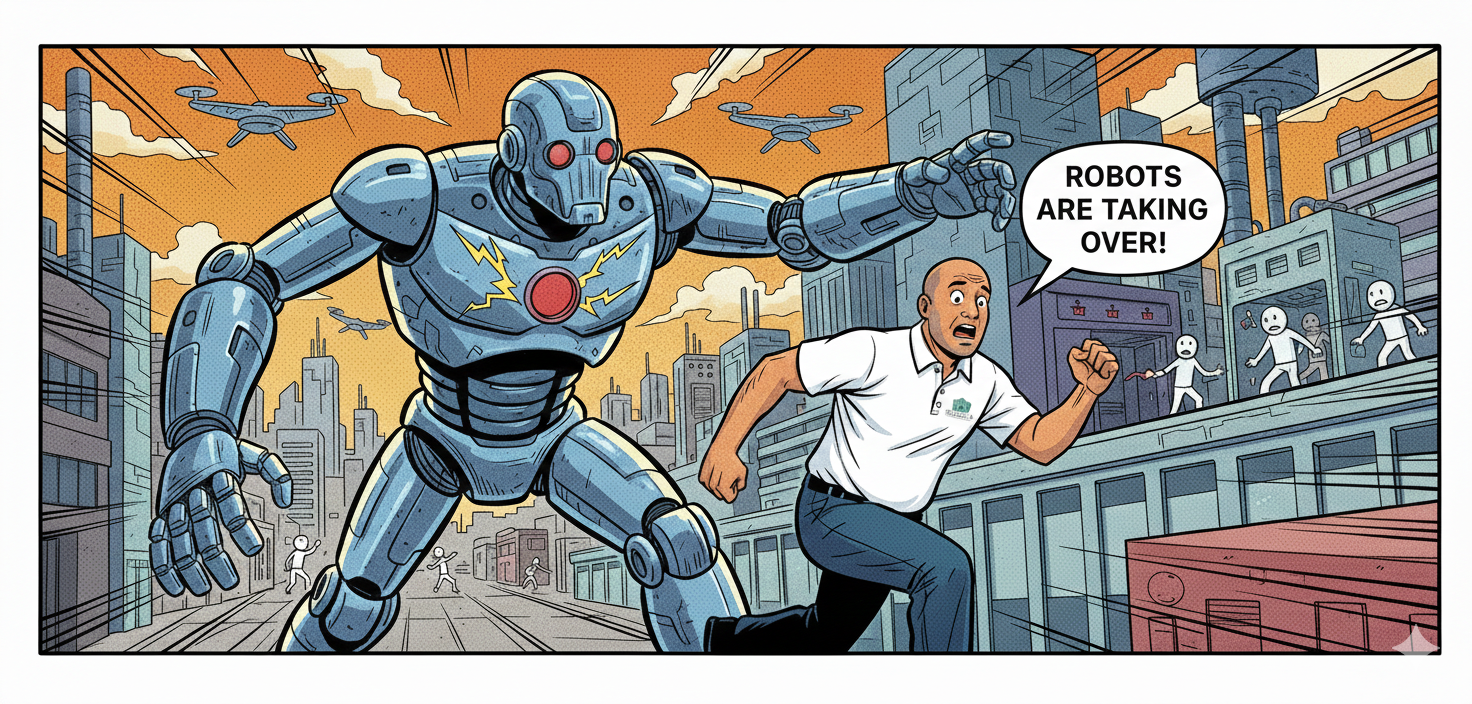
Why 99% Unemployment Might Be Near and How U.S. Section 8 Rentals could be a Canadian’s Best Lifeboat
The year is 2026, and the "robots are coming for our jobs" talk has shifted from a joke to a very real math problem. We’re standing at the edge of The Great Uncoupling—the moment where the world finally figures out how to produce everything we need without needing most of us to work.
If you're a Canadian investor looking for a way to protect your wealth, moving your capital into U.S. Section 8 housing isn't just a smart "play"; it’s the ultimate hedge against a jobless future.
Why "99% Unemployment" is Actually a Realistic Forecast
Leading experts, like computer science professor Roman Yampolskiy, are now predicting that by 2030, we could see unemployment hit 99%. That sounds wild, but the logic is simple and brutal:
The AGI Tipping Point: Artificial General Intelligence (AGI)—AI that can learn any cognitive task a human can—is expected by 2027. Once that happens, any "desk job" from coding to accounting becomes a $20-a-month subscription service.
The Muscle Joins the Brain: It’s not just white-collar work. Humanoid robots are now walking into warehouses and onto construction sites. If a machine can do the job better, 24/7, without a pension or a lunch break, the economic incentive to hire a human disappears.
The "Human Premium": In a world where machines do 99% of the work, the only jobs left will be the ones where we explicitly want another human—like high-end therapy, elite coaching, or artisanal crafts. For the other 99%, the traditional "job" is over.
Why U.S. Section 8 is a "Robot-Proof" Fortress
In a world where 99% of people aren't drawing a paycheck, how do you collect rent? This is why U.S. Section 8 (subsidized housing) is the secret weapon for Canadian investors.
1. The U.S. Treasury Is Your "Tenant"
When unemployment hits these levels, governments have to pivot to Universal Basic Income (UBI) or massive voucher programs just to keep the lights on. With Section 8, you aren't relying on a tenant’s shaky 9-to-5. You're getting paid directly by the U.S. Federal Government. As a Canadian, having your income backed by the U.S. Treasury is about as secure as it gets.
2. The USD Hedge
Let’s be honest: if the global economy gets rocked by AI, the U.S. Dollar (USD) is where everyone runs for safety. For Canadians, earning rental income in "Greenbacks" provides a massive shield against a potentially weaker Loonie. You’re building wealth in the world’s reserve currency.
3. Real Estate is "Hard" Scarcity
AI can generate infinite digital art, infinite code, and infinite videos. But it can't "print" more land. A solid 3-bedroom house in an American neighborhood is a finite, physical asset. In a world of digital abundance, physical scarcity is the only thing that holds real value.
How to Be a "Digital Landlord" from Canada
You don't need to cross the border to make this work. In fact, you can use the same AI that’s disrupting the world to manage your portfolio:
AI Property Management: 2026-era platforms now handle the boring stuff—answering 2 a.m. tenant texts, filing government paperwork, and even screening tenants using biased-free algorithms.
Predictive Maintenance: Use "Smart Home" sensors to catch a leaky pipe or a dying furnace before the Section 8 inspector shows up. AI can alert you to a problem before it stops your rent check.
Standardize to Scale: If you use the same flooring, paint, and locks across your properties, an AI-managed system can dispatch a local technician with the exact parts needed every time. No guesswork, no wasted money.
The Bottom Line
The "Great Uncoupling" is scary, but it’s also a massive reset. While the world's labor market is being rewritten by silicon, the need for a safe, government-subsidized home in the world's biggest economy isn't going anywhere.
For the forward-thinking Canadian, U.S. Section 8 housing is the ultimate seat at the table in the new economy.